
Miami County VINE Coverage
Kansas Victim Information and Notification Everyday, or VINE, is a free, confidential, voluntary custody information and alert service. The Kansas Attorney General describes access through the web, phone, text, email, mobile app, and TTY channels. For Miami County, its relevant population is adults housed in county jails, including an adult record reported by Miami County Jail.
The boundary is firm. Kansas VINE excludes KDOC prison offenders, juveniles, and federal detainees. It does not become a state-prison locator simply because Kansas operates the service. KASPER is the public system for KDOC custody and supervision. Federal sentenced custody belongs to the Bureau of Prisons locator, while current or recent ICE custody belongs to ICE's locator. The last known custodian determines which search can answer the question.
| Custody system | Kansas VINE coverage | Correct alternate source |
|---|---|---|
| Adult at Miami County Jail | Yes, when the jail reports the record | Sheriff release record and court case for confirmation |
| KDOC prison or KDOC supervision | No | KASPER and KDOC records |
| Juvenile custody | No | The responsible juvenile authority, subject to access limits |
| Federal or ICE custody | No | BOP, federal court, USMS process, or ICE ODLS as applicable |
Note: County of arrest or conviction does not make a later KDOC, federal, or ICE custody event part of Kansas VINE.
Search One Miami County Inmate
Use the Kansas-specific VINELink search or call 1-866-574-8463. Search for a known person, then verify that the reporting jail and identifiers match. Similar names can lead to the wrong record. A missing match is only a negative search result and does not establish release.
- Open the Kansas VINE search, not a general commercial custody page. Phone users may call the official Kansas VINE number.
- Enter the available name and identifying details. Use enough information to distinguish people with the same or similar names.
- Open the likely record and confirm Miami County Jail is the reporting facility. Check all identifiers that the result supplies.
- Read the exact custody status or status-change language. Do not convert a transfer notice into a community release.
- If the person is still in county-jail custody, register for the offered phone, text, email, or in-app notification.
- Confirm a later release or transfer through the Miami County Sheriff's record and the controlling court order.
A released person may no longer appear like a current inmate. VINE is built for timely status and notification, not a permanent Miami County release archive. For a past event or a name that has disappeared, use the Miami County released inmate search path to request the booking and release entry and identify any receiving agency.
Miami County VINE Result Fields
The live result should be read exactly as displayed. The research supports name and identifying fields, the reporting facility, and custody status or status-change information. It does not support promising a county release date field in every result. VINE's key value is the reported county-jail custody signal and the ability to register for notice.
| Field or signal | What it can establish |
|---|---|
| Name and identifiers | Whether the result likely refers to the intended person |
| Reporting facility | Which county jail supplied the custody information |
| Custody status | The status reported by that jail, subject to update and verification |
| Release status change | That the reporting county-jail custody ended as described |
| Transfer status change | That another custodian may now hold the person |
| Notification options | Which phone, text, email, or in-app alert channels are offered for the record |
A release alert does not replace the underlying release record. Ask Miami County Sheriff's Records for the exact release date and time, release type or authority, and receiving agency when applicable. Pair those facts with the bond, dismissal, sentencing, commitment, or other signed court order. That combination separates authorization, jail processing, physical departure, and transfer.
The official Kansas search screen shows the source interface used for a Kansas VINE check.
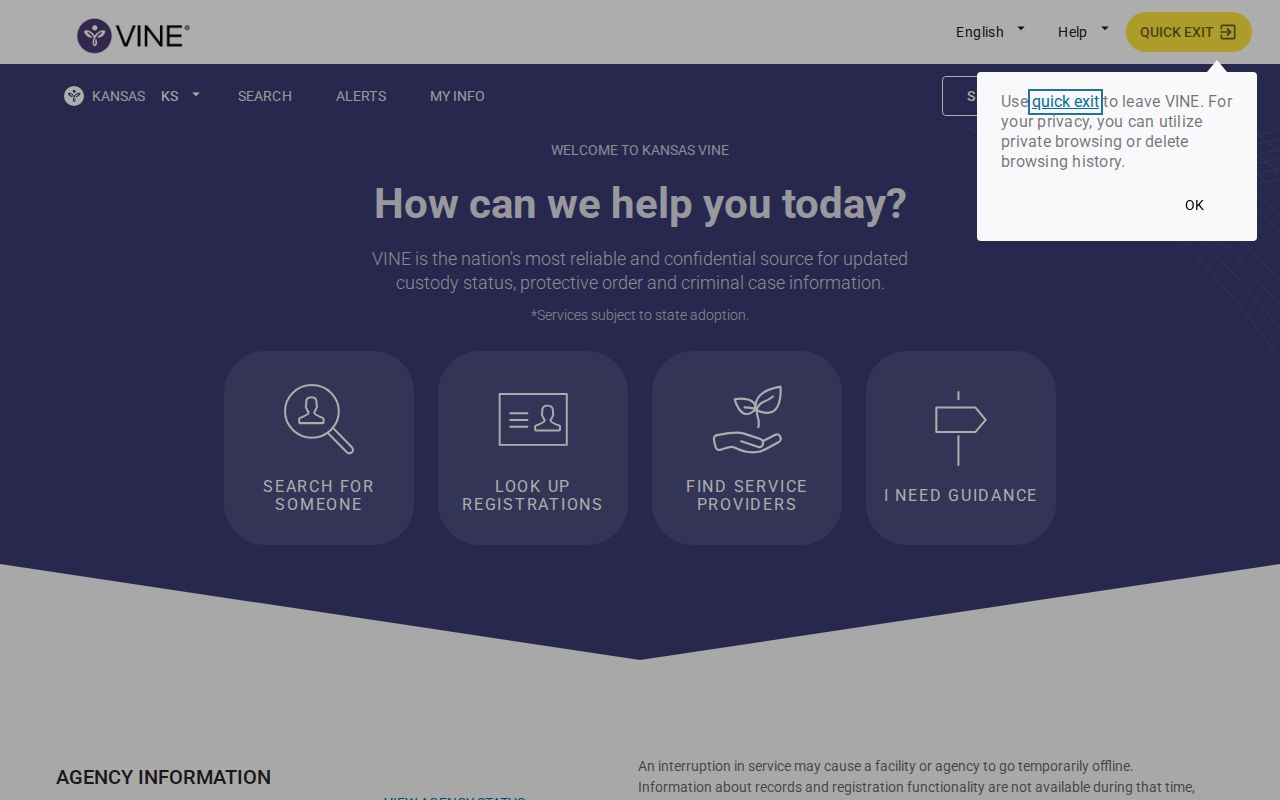
The screen is a search and alert entry point. It is not a dated Miami County release log and should not be framed as one.
Register Miami County Release Alerts
Registration works best while the adult is still reported in county-jail custody. Select the record first, then choose among the notification methods offered. The official Kansas VINE brochure gives a special acknowledgment process for phone calls and a different rule for email.
- Locate and verify the Miami County Jail record before registering. A wrong match can produce alerts about another person.
- Select notifications and enter the phone number, text number, email address, or in-app destination the service offers.
- For phone calls, create a memorable four-digit PIN. Email registration does not use a PIN.
- When VINE calls, listen to the message and enter the four-digit PIN followed by the pound sign to acknowledge it.
- If a call is not acknowledged, VINE may leave a message and keep calling for up to 24 hours. Calls can arrive overnight.
- Register more than one direct number or email when appropriate. Avoid a switchboard that cannot enter the PIN.
- If the PIN is lost, call the service and press zero to reach a representative available around the clock.
Email works differently. The brochure says one email is sent after the status change, with no PIN acknowledgment. Phone users should plan for repeat calls until the PIN confirms receipt or the calling period ends. TTY access is available at 1-866-847-1298.
Confirm a Miami County Alert
VINE warns users not to rely on the service alone. A notification is a timely signal drawn from a reporting system, while the sheriff record is the physical custody record. Miami County Sheriff's Records accepts in-person or written requests at 209 S. Pearl Street, Paola, KS 66071. The detention and records number is 913-294-3232. Ask for the named booking, exact release event, release reason or authority, and receiving agency.
Next, read the Miami County court case through the Sixth Judicial District gateway. A bond order, dismissal, sentence, satisfaction, or commitment record explains the legal cause, but the order time may precede physical departure. If the sheriff identifies KDOC as the receiver, use KASPER. A later KASPER intake supports continued state custody. Kansas VINE cannot report that KDOC prison event.
For an ICE transfer, use the ICE detainee locator. For federal sentenced custody, use the BOP locator; for federal pretrial status, the court order is usually the durable source because USMS has no universal public locator. These checks prevent one agency's release word from being stretched across a different authority.
Why Kansas VINE Is Narrow
Kansas VINE's adult county-jail-only scope is the distinctive local rule. Many people assume a statewide VINE service must include the state prison system. Kansas does not. A Miami County Jail alert must be followed into KASPER, ICE, another county jail, or federal channels when the event was a handoff.
Consider a transfer to KDOC. VINE may report that Miami County Jail custody changed. The sheriff's receiving-agency field should identify KDOC, and KASPER may later show state intake or supervision. Those are two linked custody records, not one community release. The same logic applies when ICE or another county becomes the receiver.
This scope also explains why VINE cannot answer whether a KDOC prisoner is on parole or postrelease supervision. KASPER status and KDOC records answer that question. It cannot find a juvenile, and it cannot certify a federal release. Choosing the correct source first saves time and protects the meaning of each status.
VINE also cannot recreate everyone who left Miami County Jail during a prior day or weekend. The county did not publish a functioning roster archive, 24-hour list, or 72-hour list during the research sweep. For a retrospective list, send Sheriff's Records an explicit start and end timestamp and request the existing release events for that span. For one named person, request the booking identifier, admission time, release time, release reason, and destination.
The court record answers a different part of the story. A signed bond or dismissal order may authorize release, while the jail entry records later processing and physical departure. A detainer can keep the person in custody after the local case changes. VINE may provide quick notice of the jail event, but it does not merge those legal and physical steps. Reading all three sources preserves the actual sequence.
- Custody alert
- A notice that a reporting jail supplied a status change.
- Release
- Departure from the reporting custodian, subject to the exact event label.
- Transfer
- Custody ending for one agency and beginning with another.
- PIN
- The four-digit code used to acknowledge a VINE phone call, followed by the pound sign.
- Discharge
- The later legal end of a sentence or supervision, not merely departure from jail.
Note: VINE can support prompt awareness, but only the agency record can supply a stable Miami County release history.