
Understanding Miami County Jail Release
A release record answers when and why one custodian stopped holding a person. It does not always mean freedom. Someone may leave the Miami County Jail on bond, recognizance, dismissal, probation, or after serving a local sentence. The same departure may instead be a transfer to the Kansas Department of Corrections, another county, federal officials, or immigration custody. A transfer ends Miami County custody but starts another custody episode.
Final discharge is different. A person released from prison to parole or postrelease supervision remains under state authority. Discharge marks the later end of that supervision or sentence. For that reason, the useful record set may include the sheriff's release event, the court journal entry, a KASPER status, and a discharge document. The custodian, legal reason, physical departure time, and receiving agency must all agree before the event is described.
- Time served
- The court-ordered custodial portion has ended.
- Detainer
- A request by another authority to keep or receive the person.
- Postrelease supervision
- Community supervision after the prison part of many Kansas sentences.
- Discharge
- The legal end of the sentence or supervision documented by the responsible agency.
Miami County Release Paths
The next search depends on the kind of departure. A booking photograph proves only that an image was tied to a record. A court order may authorize release before jail processing ends. VINE may report a custody change, but it is not a permanent certificate. Use the event type as a map to the next official source.
| Release path | Meaning | Next record |
|---|---|---|
| Bond or recognizance | Jail custody ends while the case continues | Sheriff release entry, bond order, bond receipt |
| Dismissal or acquittal | That charge no longer supports custody | Court disposition and jail event |
| Time served | The ordered local jail term is complete | Sentence and physical release time |
| Probation | A court orders community supervision | Journal entry and supervising office |
| KDOC transfer | County custody ends, state custody begins | KASPER intake and movement record |
| Federal or ICE transfer | Another sovereign takes custody | Federal court, BOP, USMS, or ICE record |
Miami County Release Record Fields
Miami County does not publish a county-specific release-record schema online. A focused request should name the needed fields instead of assuming the jail system contains or releases all of them. Ask the Records Division for a code legend as well. That prevents a transfer code, authorization time, or detainer notation from being mistaken for a community release.
| Requested field | What it can show |
|---|---|
| Name and booking identifier | Connects the event to the right custody episode |
| Admission date and time | Begins the county jail episode, which may follow arrest |
| Release date and time | Shows the physical event if the system records actual departure |
| Release type and authority | Distinguishes bond, court order, time served, or transfer |
| Case number and charge | Links the booking to the durable court file |
| Receiving agency | Shows where to search when custody continued elsewhere |
| Bond and detainer fields | Explains why the person left or remained held |
| Correction history | Shows whether an earlier status was amended |
Question: Does a missing name prove release? No. A live roster mainly shows current custody, and Miami County's visible roster link did not display a working roster during the research sweep. Only the dated release record and receiving-system check show what happened.
Request Miami County Release Records
The Sheriff's Central Records Division accepts requests in person or in writing. It is at 209 South Pearl Street, Paola, KS 66071. The main number is 913-294-3232 and the records fax is 913-294-9118. Published hours are Monday through Friday, 8:00 a.m. to 4:00 p.m., with holidays closed. Those are records-office hours, not a claim about when the jail processes releases.
- Identify the person, approximate booking and release dates, and any known case or report number.
- Ask for the admission and release event, exact date and time, release type, authority, receiving agency, detainer fields, and code definitions.
- Request an estimate before work begins and specify the least costly usable format.
- Ask for open portions after redaction if part of the record is closed, and request the written legal basis for withheld material.
- Match the result with the court order or receiving agency record before drawing a conclusion.
The published fee schedule lists an initial sheriff report at $5, supplemental pages at $0.25, a bond-receipt copy at $5, staff and research time, and several media charges. Payment terms on the source page should be checked before ordering. The county says report replies can take up to 72 hours based on timing and the incident. That estimate is not a promise of full production.
Kansas Law on Miami Release Records
The Kansas Open Records Act, K.S.A. 45-215 and following, sets the general access framework. K.S.A. 45-218 addresses access, while K.S.A. 45-219 permits reasonable fees that can include staff time. The law applies to existing records. It does not require an office to answer a broad question or create a custom report that does not exist.
Criminal-investigation, juvenile, sealed, expunged, medical, security, and protected personal material may be restricted. Public and closed details can share one file, so ask for redaction and release of the open remainder. No firm online-retention period for Miami County release entries was established. Web display and government retention are different. An older event may survive in a court file or agency archive after it disappears from a website.
Proving a Miami County Bond Release
A bond-out is not the same as a completed sentence. The local fee schedule makes the bond receipt a useful, specific source because a copy is listed at $5. Pair it with the court's bond order and the jail's release event. Together, the records can show the legal authorization, payment event, and physical end of county custody.
Louisburg Municipal Court has its own rules, including an 18-hour provision in specified situations and municipal bond ranges. Those rules do not govern every Miami County arrest or a district-court felony. Do not label a Louisburg release as time served unless the actual court or jail record uses that term. A warrant or separate hold can also keep the person in custody after one local basis ends.
Miami County Incarceration Letters
Miami County publishes a no-cost letter of incarceration process. The stated route is narrow: the incarcerated person or that person's attorney appears with valid photo identification. The letter may document a custody interval, but the county does not advertise it as a general public release certificate.
Before relying on the letter, ask whether it contains both admission and release dates and whether the requester qualifies. A standard records request remains the safer path for a public booking and release event. The difference matters when the goal is the exact departure time, release reason, or receiving agency rather than proof that the person was once confined.
Search Miami County Released Inmates
There is no universal search across county, state, federal, and immigration custody. Begin with the last known custodian. The Miami County jail record is primary for a local bond-out or time-served event. KASPER is for people tied to KDOC. VINE is a timely county-jail signal. The court file explains the legal basis. Federal and ICE systems cover their own custody only.
- Establish whether the person was held by Miami County, KDOC, federal officials, or ICE.
- Use the county jail page only as a current-custody check, never as proof of a historical release.
- For a county event, check Kansas VINE and ask the sheriff for the written release record.
- Open the Miami County case through the Sixth Judicial District and read the signed order.
- Use KASPER after a KDOC commitment or possible state-prison release.
- Use BOP, federal court, or ICE ODLS only when that system held the person.
KASPER Miami County Release Lookup
The Kansas Adult Supervised Population Electronic Repository, or KASPER, is the statewide path for KDOC custody and supervision. It is not the Miami County jail roster. Accept the disclaimer, search by KDOC number when known, or use exact identity fields. Then verify the photograph, physical details, conviction county, case number, and status before reading any date.
The live search offers name, alias, KDOC number, State ID or KBI number, race, gender, date of birth, age range, conviction county, and parole-supervision county. Miami can be chosen for conviction or supervision. KASPER updates each working day rather than in real time, and it cannot currently display newer community-corrections probation events reliably.
| KASPER field | How to use it |
|---|---|
| KDOC number | Best direct identifier when known |
| Name and alias | Start broad, then verify the exact person |
| Conviction county | Narrows cases connected with Miami County |
| Status and location | Distinguishes custody, supervision, and inactive records |
| Anticipated guidelines release date | A forecast, not proof of departure |
| Parole office | Shows the KDOC supervision channel when published |
The official KASPER screen shows the state search entry used for a KDOC record.
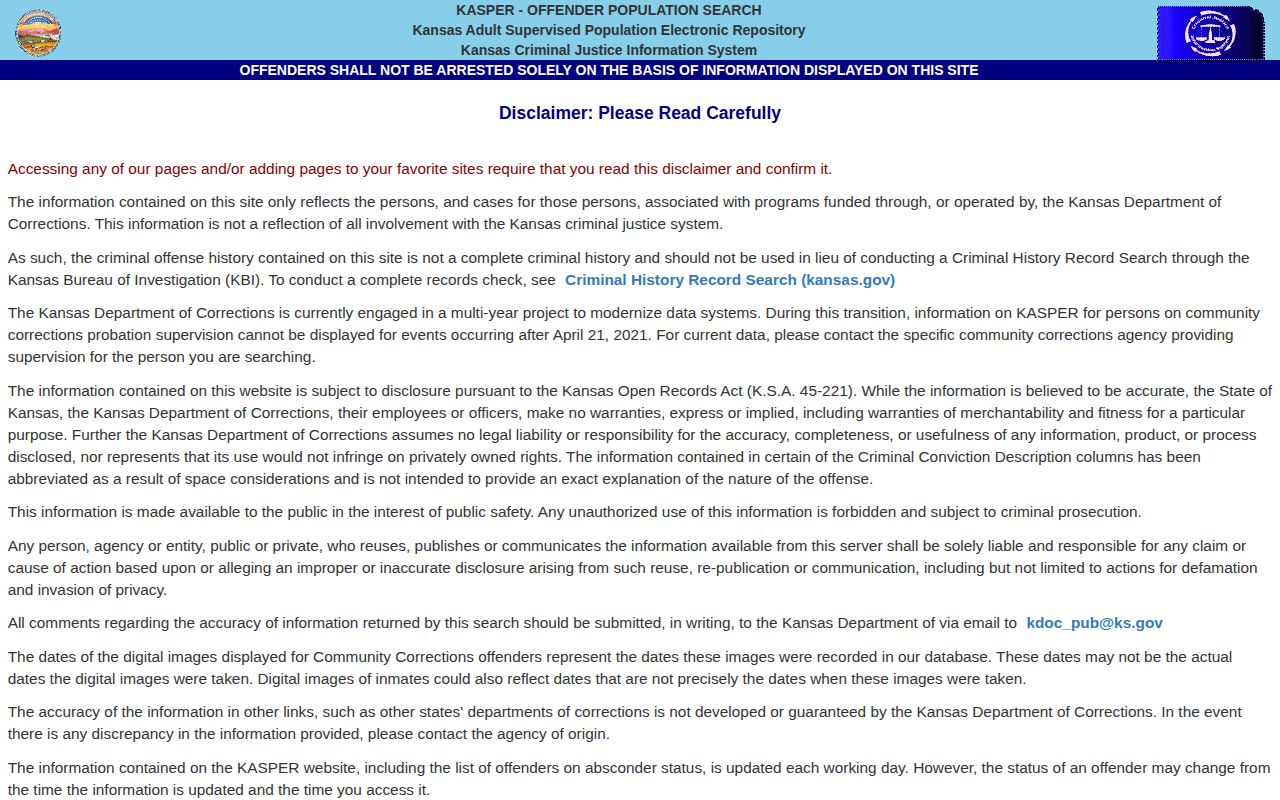
Read the returned date label word for word because parole eligibility, conditional release, sentence expiration, and anticipated release describe different events.
Miami County Court Release Proof
Miami County is in the Sixth Judicial District. Its records gateway directs users to the statewide public portal and courthouse terminals. Search by exact name and case number, verify Miami County, then read signed bond, dismissal, sentence, commitment, probation, or discharge documents. A docket event can explain why release was authorized, but the sheriff log supplies the physical departure time.
Older converted documents may be missing online even when a public copy can be viewed at the courthouse. Spring Hill also spans Miami and Johnson counties, so determine where the case was filed before choosing a court path. A blank portal result may reflect conversion, restriction, sealing, or the wrong county. It does not prove that no case or release exists.
Miami County Recent Release Records
As of the research sweep, no official 24-hour list, 72-hour list, functioning roster archive, release feed, mobile inmate app, update schedule, or web retention period was found. Visible “Inmate Roster” links returned to the descriptive jail page without names or filters. That finding should not be enlarged into a claim that no internal roster database exists.
For a day or three-day window, request all release events between exact timestamps and ask for release type, authority, and receiving agency. Kansas VINE can alert on one registered adult county-jail person, but cannot rebuild a past countywide list. KASPER cannot list ordinary county bond-outs. Court records show case outcomes, not a reliable roll of everyone who physically left the jail.
Miami County Jail Release Times
Miami County does not publish general release-processing times or a public exit location. The detention and records contacts share 913-294-3232, but the Records Division's weekday office schedule is only an inquiry schedule. It does not limit when detention staff can process a court-ordered release or transfer.
Call the jail about the specific event before arranging a pickup. Do not assume that a person will leave during business hours, through a named door, or immediately after a judge signs an order. Authorization, processing, and physical departure can be separate points in the record.
Miami County Post-Release Supervision
Parole, postrelease supervision, and probation are separate. The Kansas Prisoner Review Board handles parole decisions for eligible older-law KDOC cases. KDOC supervises parole and postrelease cases. Probation begins with a court order and may be handled by court services or community corrections. The Miami County parole and probation resource explains how to verify each path.
A KASPER parole or postrelease status means the person left prison but remains under state rules. For local probation, use the journal entry and Sixth Judicial District Community Corrections because KASPER has a stated gap for newer community-corrections events. Absconder status is not discharge. Final discharge is a separate dated action.
Miami County VINE and Federal Releases
Kansas VINE covers adults housed in Kansas county jails. It does not cover KDOC, juveniles, or federal detainees. A “released” or transfer alert marks departure from the reporting jail and still needs sheriff and court confirmation. Register while the person is in custody because VINE is a notification service, not a complete historical archive.
The BOP locator covers sentenced federal inmates from 1982 forward. A past date with “Released” or “Not in BOP Custody” confirms departure from BOP, not the end of every other case. ICE ODLS covers current and recent immigration custody within its stated window. A county-to-ICE handoff and a later ICE release are two separate events.
Miami County Custody Status Sources
Match the source to the custodian. A current roster, release log, state offender file, and federal locator are not substitutes for one another.
| Situation | Best source | What it proves |
|---|---|---|
| Still in Miami County Jail | Jail contact and current system | Present county custody |
| Released from county jail | Sheriff release event plus court order | Departure time and legal reason |
| Transferred to KDOC | KASPER intake and movement | Continued state custody |
| Released from Kansas prison | KASPER status plus KDOC record | Prison departure and supervision |
| Federal release | BOP locator or federal court | End of BOP or federal pretrial custody |
| ICE custody change | ICE ODLS and county transfer record | Separate county and immigration events |
Miami County Jail Record History
The current Miami County Jail opened in 2018 and has 96 beds. Older records may have been created under a prior building or records system, so request by person and date instead of assuming the current website holds a complete archive. The jail's age and capacity do not establish release times, processing rules, or online retention.
The Miami County Jail in Paola is the county's only confirmed operating adult detention facility in the facility map. Its current web page is not proof that records created before the present building opened are unavailable.
Spring Hill's Historic City Jail
Spring Hill's preserved 1926 strap-iron Original City Jail is a historical landmark, not an active detention facility. It should never be used as a custody or release-record contact. The old structure now stands downtown, while adult detention for the Miami County side of current cases routes through the active county and court systems.
Spring Hill spans Miami and Johnson counties. Confirm the arrest location and filing county before searching, because the historic jail's location does not resolve present jurisdiction. A current Miami County booking belongs with the sheriff in Paola and the relevant Miami County court record.
Miami County Release Facility
The Miami County Jail release page covers the county's active adult facility, its records contact, and each possible destination after departure. Municipal police may book people there, but no separate operating city jail was confirmed. A state, federal, or ICE transfer moves the search to that receiving authority.