
Miami County Scheduled vs Actual Release
A scheduled date answers when release may occur if the present sentence calculation remains unchanged. An actual release date records an event that already took place. The distinction matters. A court can authorize release before jail staff finish checks, return property, review holds, and complete the physical departure. A Miami County Jail log can therefore show a later time than the court order. Both records may be accurate because they describe separate steps.
State records add more date types. Parole eligibility is the first point when an eligible older-law case may be considered. Conditional release is a statutory sentence stage. Sentence expiration is another endpoint. Discharge can mark the end of supervision. None should be renamed as an actual prison release. The Kansas Department of Corrections uses the precise phrase anticipated guidelines release date for forward-looking sentence information. Read that label as a forecast based on the current calculation.
Miami County Release Date Routes
There is no universal name search for every person connected to Miami County. Start with the last known custodian. The active local facility is Miami County Jail at 209 S. Pearl Street in Paola, and the county maintains an official jail information page. Kansas prison commitments are tracked statewide by KDOC. Federal and immigration authorities use separate systems. A transfer closes one agency's custody event and opens another, so it must not be called freedom.
- County jail or local sentence: Call Miami County Jail at 913-294-3232. Ask whether the person is still held, released, or transferred. Request the written booking and release event from the Sheriff's Records Division.
- Kansas prison sentence: Open the official KASPER search. Confirm the KDOC number and identity before reading status, location, supervision, and the exact date labels.
- Probation: Read the Miami County court journal entry and later termination or discharge filing. Ordinary county probation may not have a useful KASPER date.
- Federal sentence: Search the official BOP Inmate Locator. A past date paired with “Released” or “Not in BOP Custody” concerns BOP custody only.
- ICE custody: Use the ICE Online Detainee Locator for current and recent ICE custody. A county-to-ICE transfer and a later ICE release are two different events.
For a county-jail case, the court record explains the legal reason while the jail record supplies the physical timestamp. Miami County belongs to the Sixth Judicial District, whose district-court records gateway directs users to state search and courthouse access. A signed bond order, sentence, commitment, dismissal, or probation order can explain the next step, but another hold may still prevent community release.
KASPER Miami County Release Dates
KASPER is the Kansas Adult Supervised Population Electronic Repository. It covers people associated with KDOC programs, not ordinary Miami County bond-outs. The search offers name, alias, KDOC number, State ID or KBI number, race, gender, birth date, age range, conviction county, and parole-supervision county. Miami may be selected as a conviction or supervision county. A KDOC number is the strongest starting key when known.
Open the matching detail only after checking the photograph and identity facts. Then copy each date exactly as labeled. A custody or facility status means the person remains in physical KDOC care. Parole or postrelease supervision means the person left prison but remains under state rules. Discharged or inactive wording can indicate KDOC authority ended, though an unrelated case may still exist.
The official KASPER disclaimer and search shows where the lookup begins:
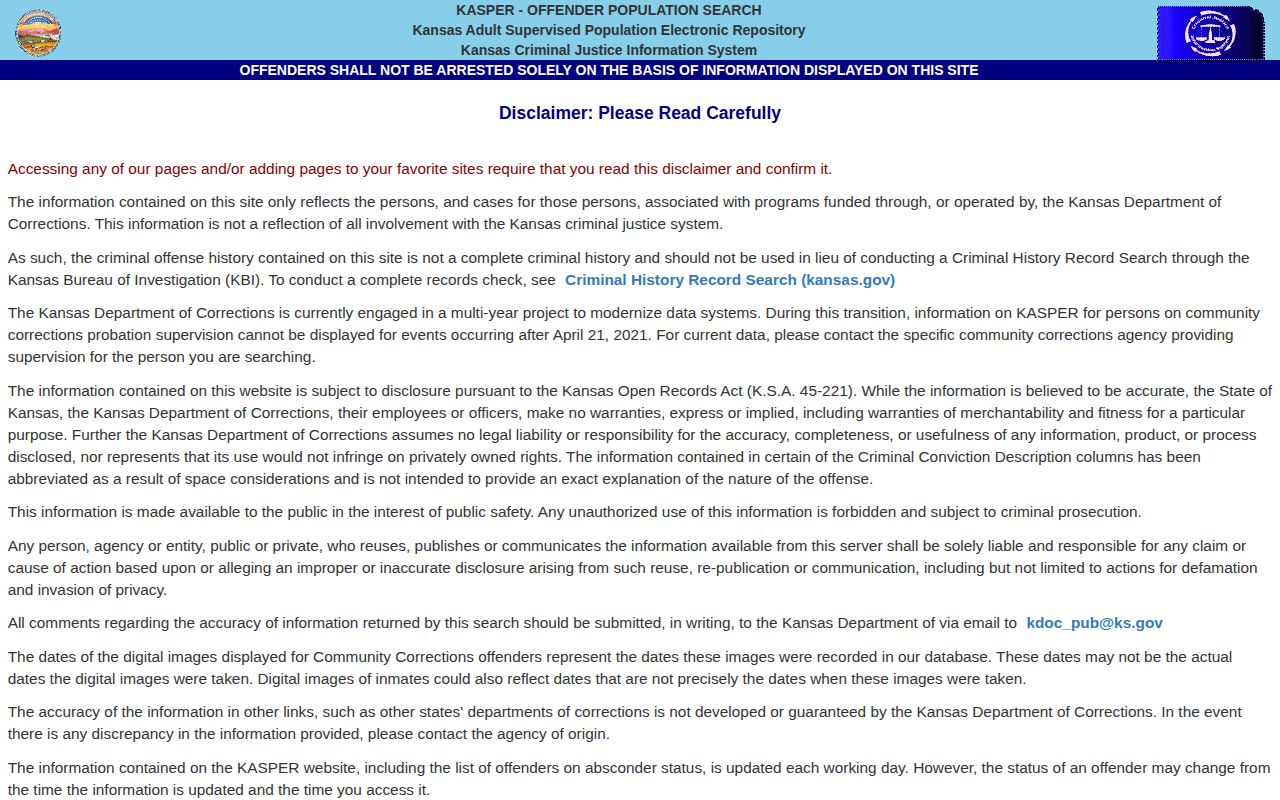
The screen supports a statewide search, but its own limits matter. KASPER is not a complete account of all Kansas justice involvement, and the research found that it updates each working day rather than at the instant of every movement.
| KASPER item | What it can establish | What it cannot establish alone |
|---|---|---|
| Anticipated guidelines release date | Current KDOC sentence forecast | That physical release occurred |
| Parole eligibility date | Possible consideration point for an eligible case | A grant or departure date |
| Parole or postrelease status | Prison custody ended and supervision continues | Final discharge from the sentence |
| Facility movement | A change within KDOC custody | Community release unless the status says so |
| Discharged or inactive status | Possible end of KDOC authority | Freedom from every other authority |
Note: KDOC also warns that a recorded image date may differ from the date the photograph was actually taken.
Kansas Good Time Release Math
Kansas good time is earned sentence credit. It is not a promise of release on a fixed percentage date. K.S.A. 21-6821 governs good-time and program credits for covered guidelines sentences. Under the statute, a maximum 15 percent good-time credit applies to many categories. Specified lower-severity categories can have a 20 percent ceiling. Eligible program credit can reach 120 days. The sentence category, offense date, conduct, program eligibility, and later forfeiture or restoration all matter.
That framework explains the common “85 percent” shorthand: one hundred percent less a 15 percent maximum. It is not universal. A person may fall within a different credit ceiling, be unable to earn the maximum, lose credit, regain some credit, earn program credit, or face another sentence or hold. Applying 85 percent to a raw sentence can produce a wrong Miami County inmate release date.
Older indeterminate cases may turn on minimum terms, good-time rules, and parole eligibility. Modern determinate guidelines cases often move to mandatory postrelease supervision when the prison part ends. K.S.A. 22-3717 contains extensive exceptions and special terms. The journal entry and KDOC calculation, not a simple web calculator, control the individual case.
Why Miami County 85% Estimates Fail
The local search problem is not a lack of arithmetic. It is a lack of all the inputs. A Miami County court case may involve jail credit, more than one count, consecutive or concurrent terms, probation revocation, a later amended order, or a commitment to KDOC. K.S.A. 21-6821 then applies different credit rules by sentence class and conduct. Program credit is a separate variable.
Use the 85 percent phrase only to explain where one shorthand comes from. Never present it as an individual prediction. Ask KDOC for sentence-structure material if the public fields do not resolve the date. The KDOC open-records portal accepts a targeted request that identifies the person, KDOC number, and the exact calculation or movement record sought.
Miami County Release Date Changes
A forecast changes when one of its legal or factual inputs changes. Some changes move the date. Others change where the person goes. A detainer, which is another authority's request to keep or receive the person, can prevent community release even when the current sentence date arrives.
| Factor | Possible effect | Best record to check |
|---|---|---|
| Good-time award or loss | Moves the projected prison date | KDOC sentence calculation and discipline record |
| Program credit | May reduce an eligible guidelines term | KDOC credit record under K.S.A. 21-6821 |
| Amended court order | Changes sentence structure or jail credit | Signed Miami County journal entry |
| Detainer or warrant | Causes continued custody or transfer | Jail release record and receiving agency |
| Parole action | Grant, denial, pass, or later consideration | Official PRB or KDOC action |
| New case or revocation | Adds custody or alters supervision | Court docket and custodian record |
A Prisoner Review Board monthly public-comment list is not a release decision. It marks a process stage. Eligibility also differs from suitability and approval. If parole is granted, the later movement and supervision status are stronger proof that prison departure occurred.
Miami County Jail Release Timing
A pretrial detainee usually has no computed release date. Release can depend on bond, recognizance, dismissal, a hearing, or another court order. A county-sentenced person may have a more definite endpoint, but Miami County does not publish a county-jail good-time formula. Do not import one from another Kansas county.
The Miami County Sheriff's Records Division accepts requests in person or in writing at 209 South Pearl Street, Paola, KS 66071. Its hours are Monday through Friday, 8:00 a.m. to 4:00 p.m., excluding holidays. Ask for admission date and time, release date and time, release type or authority, and any receiving agency. The office says some report replies may take up to 72 hours depending on timing and the nature of the event. That is not a guaranteed release-record deadline.
Call 913-294-3232 for an immediate status question. Records-office hours are not release hours, and no general public departure time or exit door was confirmed. If the person left on bond, the county's $5 bond-receipt copy can help document that event when paired with the court order and jail release log.
Confirm Miami County Actual Release
For a county departure, pair the sheriff's release entry with the Miami County court order. Kansas VINE may give a timely alert for an adult held in a county jail, but it does not cover KDOC prison inmates, juveniles, or federal detainees. The Miami County VINELink release check explains that limited alert route. A transfer alert should prompt a search of the receiving system.
For a Kansas prison departure, read KASPER status and movement together. If the person is on parole or postrelease supervision, physical prison release occurred but final discharge did not. For a past event that needs more precision, request the official KDOC movement or release record. Keep the anticipated date, actual movement, supervision start, and discharge as separate facts.
- Release
- Physical departure from one custodian, either to the community or another authority.
- Transfer
- Departure from one agency followed by custody under another.
- Postrelease supervision
- Community supervision after the prison part of many Kansas guidelines sentences.
- Discharge
- The legal end of the sentence or supervision under the responsible authority.
Note: A missing name or stale status is not proof of release; confirm the date, legal reason, and destination with the office that created the event.
Public Record Search
Sponsored Results